By: Christopher Taylor
1938: Gays and lesbians begin to be officially rounded up by the Gestapo in Germany and its conquered territories, and sent to the concentration camps. They are ordered to wear purple triangles to identify themselves (Wolf, 2009, p. 59).
1934: In July, the Night of Long Knives occurs in Germany. Hitler removes ‘leftists’ from the National Socialist Party. One of the targets is Ernst Rohm, who is accused of creating homosexual cliques among the Nazi militias (Adams, 1987, p. 52).

(May 10th burning of books by the Nazis. Some of these may have been leftovers from the May 3rd burnings of the Scientific-Humanitarian Committee's material, the largest archive of gay and lesbian texts and photos from before the Second World War).
1933/1934: Burnings in Berlin, the Night of Long Knives
Dear Diary,
Things are growing dark across the world for those of us in the LGTBQ community. Germany has always been where most of the leadership for the community has come from, ever since the Scientific-Humanitarian Committee was founded in 1897. Throughout the 1900s, 1910s, and 1920s, they and the other groups within the German community fought to change the laws of Germany and to represent gays so that they would no longer be the target of persecution. All of that changed today.
In Berlin, one hundred student members of the Nazi party attacked the Institute, burning 12,000 books and 35,000 pictures, destroying much of the history of the gay rights movement in Germany, and beyond, since they were at the heart of much of the movement (Adams, 1987, p. 50-51). Hitler is already talking about how gays are ‘Anti-Aryan,’ impure, and diseased, how they threaten his image of a perfect German nation.
This marks, perhaps, the beginning of the end for the open elements of the gay movement until after the Second World War. At this point, gays begin being openly targeted in Germany and in other areas occupied by the Germans.
With regret, dear diary, my previous predictions of better fortune have proven false. These are dark times for gays and lesbians around the world, indeed.
Sincerely,
Chris Taylor

(Photograph of Radclyffe Hall, writer of The Well of Loneliness, perhaps the first publicly successful pieces of lesbian fiction in the modern era.)
Dear Diary,
I finally managed to purchase a copy of Radclyffe Hall’s book The Well of Loneliness. I had to travel to the US to get a copy of it, since it was banned in Britain after an obscenity trial (Duder, 2010, p. 28-29). The book’s main character is a man named Stephen Gordon, who calls himself a ‘congenital invert,’ which, at this time, means someone who is either lesbian or gay (and usually the former). In 1929, the US allowed the book to be published after another obscenity trial. Apparently, 100,000 copies were sold in its first year alone (p. 29)! Hall used a lot of the language of the day from sexology to define lesbianism and homosexuality. Even the term ‘congenital invert’ suggests that being gay was something one was born with, which could be treated medically. The character “popularized the medical definition of homosexuality as an inescapable, emotionally tormenting, natural deviance” (Wolf, 2009, p. 51).
Even though later lesbians would continue to read it, and it continued to be a symbol for the LGBTQ movement as a ‘first’ for a lesbian writer, many continue to view it as portraying gays in a negative fashion. The main character is tormented, lonely, and introverted. Still, the book remains popular to the present day.
Seems like things are finally starting to look a little better for the community, despite all the challenges.
Sincerely,
Chris Taylor
1920s: The Soviet Union rejects persecution of gays, calling what happens in the bedroom a private matter. However, by the 1930s, half of the Communist party leadership is arrested, and several charged as homosexuals by Stalin (Adams, 1987, 46-47). The earlier Soviet attitude leads to much of the leftward drift of the gay rights movement, and targeting by those on the right.
1919-1921: The pro-gay Institute for Sex Research is founded in Germany. By 1921, the World League for Sexual Reform, a global organization for gay rights, has a membership of 130,000 (Adams, 1987, p. 23-24).

(Maude Allen, as Salome, in the Oscar Wilde play of the same name, from an earlier production from the London version during which time she faced lurid accusations.)
Dear Diary,
Maude Allen, a Canadian-born dancer, was supposed to perform the leading role of Salome in Oscar Wilde’s play of the same name. Maud was born in Toronto, in 1880 (Lesbian and Gay Heritage in Toronto, 1982, p. 3). She moved around a lot as a child, to San Francisco as a child with her family, and to Europe for about five years to study music and dance (p. 3). She debuted in Vienna as a performer in 1903 (p. 3).
Unfortunately, the play was attacked in a newspaper article by Noel Pemberton-Billing. He accused it of being a front for the German Black Book—an organization of nearly 47,000 people accused of having “doubtful morality,” which at this time, meant being gay (p. 3). Allen was also accused by Pemberton-Billing of being part of another secret society attempting to use their access to political leaders in England to spy on the British during the war (p. 3). The accusations were dropped only when Allan sued Billing for libel. She continued to dance and perform until 1938, when she was injured in an automobile accident, and even served as an ambulance driver (p. 3).
This goes to show that the attacks against the LGBTQ community were not just against men, but women also, and often gays and lesbians were used as scapegoats in a conspiracy theory. Years later, the Nazis would do the same thing.
Also in 1918: While certainly not as public as the Allen trial, there was a more positive example of gay and lesbian activity during the time period. In 1918, Edith (Bud) Williams and Frieda Fraser began their life-long correspondence and relationship (Duder, 2010, p. 35). Fraser became associate professor at the University of Toronto in 1936, full professor in 1949, and Williams became only the second woman in Canada to graduate from veterinary school, in Guelph, in the 1930s (p. 36-37). While this is not the only example of lesbian writing, or even of lesbians living together, their letters are the largest body of lesbian writing from the pre-WWII era, and one of the longest-lasting.
In short, dear diary, while things were still very grim for LGBTQs, at least there was some light for some people in Canada.
Sincerely,
Chris Taylor
1915: Emma Goldman tours the US on a speaking tour to support gay rights (Adams, 1987, p. 41). She eventually lives in Toronto three times: in 1926, 1934-1935, and 1939-1940, when she passed away at Toronto General Hospital. Her house was at 324 Spadina (Lesbian and Gay Heritage in Toronto, 1982, p. 3-4).
Chris Taylor
1915: Emma Goldman tours the US on a speaking tour to support gay rights (Adams, 1987, p. 41). She eventually lives in Toronto three times: in 1926, 1934-1935, and 1939-1940, when she passed away at Toronto General Hospital. Her house was at 324 Spadina (Lesbian and Gay Heritage in Toronto, 1982, p. 3-4).
1914: British Society for the Study of Sex Psychology founded (Adams, 1987, p. 37).
1907: Germany's Eulenburg Scandal. A paper in Berlin accuses the highest ranks of the German government of engaging in homosexual activities. A crackdown ensues on the paper and on gays in Germany (Adams, 1987, p. 21).
1906: Flora MacDonald Denison represents Canada at the International Suffrage Alliance in Copenhagen. This leads to a lifetime of working with lesbian and feminist activists (Lesbian and Gay Heritage in Toronto, 1982, p. 3).
1897: Founding of the Scientific Humanitarian Committee in Berlin by Max Spohr, and Erich Oberg. One of the first pro-gay organizations in the world in the modern world (Adams, 1987, p. 17).

(Regina’s warehouse district in 1903, eight years after the Hoskins trial. By this point, Hoskins had already left town due to an informal exile.)
May 22nd, 1895:
Dear Diary,
My goodness, this has been a terrible time to be a gay or a lesbian in public! In February, Oscar Wilde—yes, the Oscar Wilde, the playwright—sued the Marquess of Queensbury for calling Wilde a sodomite. This was not punishable by death or even major imprisonment, anymore, but the charge was serious enough. Wilde lost the trial—which mean that Queensbury’s accusation was accurate. Wilde himself was taken to court by the British government in April. The judge called him a “corruptor of youth,” and the “centre of a circle of extensive corruption of the most hideous kind among young men” (Adams, 1987, p. 35), even though the people Wilde was involved with were of age! He was condemned to two years of hard labor (32), and died a few years later. Wilde was able to be tried because of existing British laws concerning protecting young men and women from being 'corrupted,' as opposed to sodomy (which was no longer as big a legal threat), therefore ensuring that the courts had a precedent for attacking gays for some time to come (Bulllough,1979, p. 40)! From a Canadian’s perspective, Robbie Ross, one of Wilde’s friends, was himself put on trial in 1914, and was forced to retire in shame from public life (Lesbian and Gay Heritage in Toronto, 1982, p. 2).
Furthermore, this lead to copycat trials all over the British Commonwealth, including in Canada. On May 22nd, 1895, Frank Hoskins, of Regina, and two “young boys” (in fact 17 and 26), were arrested for gross indecency, and accused of ‘Oscarism’ by locals (Dick, 2009, p. 107, 113). By this point in Canadian history, the government had changed the laws concerning male homosexuality to include charges of 2-5 years in prison (117)—laws which would remain on the books for 77 years (119). Hoskins and the two other men (Hume and McPherson) were caught together by onlookers who had followed them home, and looked through Hoskin’s store windows (123-127). Hoskins was fined 200$, and McPherson and Hume 50$ and 20$, respectively (131-133). The trio never returned to the community, and Hoskins, a formerly successful businessman, never resurfaced. This setback to the LGBTQ community was one of many trials against gays throughout the early 20th Century, and while the gay community had many gains, these and other incidents caused many gays to remain in the closet. It also began the public perception of gays as being effeminate aesthetes. Ironically, many gays began to find each other through newspaper descriptions of ‘gay’ clubs in the newspapers covering the various trials (Wolf, 2009, p. 42).
More information as it becomes available, dear diary!
Chris Taylor
1880s: In France, one study reports 7,242 homosexuals found by the Paris police, of whom 3,049 were Parisians, 3,709 from the provinces of France, and 484 were foreigners (Bullough, 1979, p. 6).

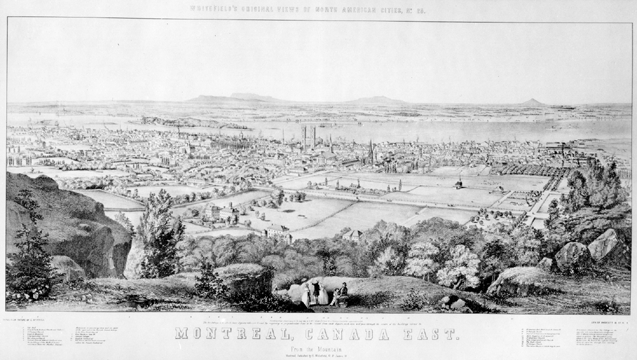
(The view from Mont-Royal looking over Montreal, 1852. This would have been a decade and a half before Moise Tellier’s arrest.)
Dear Diary,
This month was quite eventful! Ten years ago, Parliament passed the Consolidated Statutes of 1859. This repatriated the laws of our British heritage to Canada. Unfortunately for individuals who are gay, lesbian, bisexual, or two-spirited, the laws kept the old sodomy laws on file for Canadian law (Dick, 2009, p. 117). The death penalty would still be carried out on anyone caught. That said, by this year (1869), the law now only provides a life sentence as a maximum punishment.
This was fortunate for Mister Moise Tellier of Montreal! Tellier was a businessman, who owned a cake and apple shop on Craig Street (modern St-Antoine). The rumors about Mr. Tellier were that the shop was a place for men to go and be able to meet and, possibly, have sex with other men. It was one of, if not the first relatively open establishment for gays in all of Canada. Mr. Tellier was arrested when he attempted “indecent assault” on a police constable in Montreal (Bulletin des Archives gaies du Quebec, 1992, p. 3). Whether this was an actual assault, a form of entrapment, or an elicitation of sexual activity is not presently clear.
In short, dear diary, a lot of things are going on for gays and lesbians in Canada this year, and not all of it good!
Yours sincerely,
Chris Taylor
1864: Karl Ulrichs, a Hanover lawyer, publishes arguments in his books that suggest that homosexuality is a congenital issue, like left-handedness or cleft palates (Adams, 1987, p. 14).
1810: Alexander Wood, a Toronto businessman and politician, is accused of illicit (homosexual) activities with other men in the city, and informally exiled for two years. In 1823, when he attempts to run for office once again, “Chief Justice Powell refused to receive Wood’s oath of office” (Lesbian and Gay Heritage in Toronto, 1982, p. 1). This is one of the first instances of anti-gay prosecution in Canada.
Sources:
1933 Book Burnings (1933). [Nazi/SS officers burning books in Berlin, May 10, 1933]. United States Holocaust Memorial Museum. Retrieved January 17th, 2011 from http://www.ushmm.org/research/library/bibliography/photo.php?lang=en&content=1933_bookburning
1933 Book Burnings (1933). [Nazi/SS officers burning books in Berlin, May 10, 1933]. United States Holocaust Memorial Museum. Retrieved January 17th, 2011 from http://www.ushmm.org/research/library/bibliography/photo.php?lang=en&content=1933_bookburning
Adams, B. (1987). The Rise of a Gay and Lesbian Movement. Boston: Twayne Publishers.
Bullough, V. (1979). Homosexuality: A History. New York: New American Library.
Bulletin des Archives gaies du Quebec (1992). Quebec: L’Archigai: Archives gaies du Quebec. Retrieved January 12, 2011, from http://www.agq.qc.ca/fileadmin/Archigai/Archigai_1992.pdf
Dick, L. (2009). Same-sex Intersections of the Prairie Settlement Era: The 1895 Case of Regina's "Oscar Wilde.” In Social History (42:83), pp. 106-145 Retrieved January 9th, 2011, from http://search1.scholarsportal.info.myaccess.library.utoronto.ca/ids70/view_record.php?id=1&recnum=0&log=from_res&SID=58869ab291b9e8f7278a2ab02bc4c56b&mark_id=search%3A1%3A0%2C0%2C1
Duder, Cameron (2010). Awfully Devoted Women: Lesbian Lives in Canada 1900-1965.Vancouver: UBC Press.
“Lesbian and Gay Heritage in Toronto” (1982). Toronto: Canadian Gay Archives.
“Maude Allen as Salome.” (c.1906-1910). [Actress dancer Maude Allan as Salome, c. 1906 – 1910]. Wikipedia Media Commons. Retrieved January 21, 2011, from http://en.wikipedia.org/wiki/File:MaudeAllanSalomeHead.jpg
Radclyffe Hall (1928). [Photograph of Radclyffe Hall]. Photograph courtesy of Russell-Hulton
Archives. Britannica Online. Retrieved January 16th, 2011, from http://www.britannica.com/EBchecked/media/56904/Radclyffe-Hall-1928
Warehouse District and Railyards (c1903). [Photograph of the warehouse district and railroads of Regina]. Regina: the Early Years. Retrieved January 16th, 2011, from http://scaa.usask.ca/gallery/regina/north/warehouse_b_571.html
Whitefield, E. (1852). [Montreal from Mont Royal]. McGill Archives. Retrieved January 17th, 2011, from http://www.archives.mcgill.ca/pictures/pr014517.gif
Wolf, Sherry (2009). Sexuality and Socialism: History, Politics, and Theory of LGBT Liberalism. Chicago: Haymarket Books.


No comments:
Post a Comment