LGBTQ Events, After 1980

December 8, 2010: Bill C-389 - based on which the Canadian Human Rights Act will include “gender identity” and “gender expression” as prohibited grounds of discrimination - passes report stage. The bill’s adoption would ensure better protections for transgendered people in Canada (Egale Canada).

2005: Bill C-38 is passed, legalizing same-sex marriage throughout the country (Rapp, 2006, p. 6-7).

2003: United Church of Canada votes overwhelmingly to endorse same-sex marriage (Rapp, 2006, p. 7).

June 10, 2003 - "The Michaels" Get Hitched!
Photo of Michael Stark (left) and Michael Leshner (right) at their wedding ceremony in Toronto on June 10, 2003.


Dear Diary,

Today is a great day! The first same-sex marriage in Canada has officially taken place in the city of Toronto.

After Egan and Nesbitt were denied this very opportunity in 1995, I can hardly believe that after almost ten years this day has come (Kinsman, 1996, p. 5). Even as late as 2002 the Superior Courts in Ontario, Quebec and British Columbia ruled that same-sex marriage would be a violation of the Charter of Rights and Freedoms (Rapp, 2006, p. 6). So it is quite an about-face to see that the opposite ruling has been given and same-sex couples can now marry in Ontario.

The lucky two who have the honour of being the first same-sex couple married in Canada are Michael Stark and Michael Leshner. In fact, immediately after the Ontario Court of Appeal ruled that same-sex couples could marry, defining marriage as “the voluntary union for life of two persons to the exclusion of all others,” Stark and Leshner did just that (Rapp, 2006, p. 6). They are the very first, just as Ontario is the first province to rule in favour of same-sex unions, but I have a feeling that many more will follow suit – both provinces and couples.

I interpret this as a victory for LGBTQ Canadians. Of course, I imagine that there will be many who continue to feel that getting married is a relatively mainstream practice, which they may well balk at. Others will be eager to finally have the chance to do so. This to me simply points to the variety within LGBTQ communities; not everyone is interested in the mainstream. Some view marriage, in spite of this change, as an oppressive practice (Warner, 2002, p. 192). In the end, to have the option, in my estimation, is in keeping with Section 15 of the Charter of Rights and Freedoms as it ensures equal rights to all Canadians and that is something to be celebrated.

I raise my glass to Michael and Michael!
Cathy


May 25, 1995: Supreme Court denies Jim Egan and Jack Nesbitt recognition as couple (Kinsman, 1996, p. 5).

June 9, 1994: Ontario legislature defeats Bill 167, denying benefits and family-recognition to same-sex couples (Kinsman, 1996, p. 2).


October 1992 - Douglas Verdict Protects Lesbians and Gays in the Military
Photo of Michelle Douglas, who successfully challenged the ban on lesbians and gays in the Canadian military.

From Mackenzie, I. (November 28, 2002). Who’d want to tell? Anniversary – Policies can’t make it all easy for gay soldiers. Xtra! Retrieved from http://archives.xtra.ca/Story.aspx?s=14721261

Dear Diary,

Michelle Douglas challenged the Canadian Armed Forces for its ban on LGBTQ soldiers and won!

Now, a bit on the back story: Douglas joined the military in 1986 and quickly showed herself to be a star recruit (Kinsman & Gentile, 2010, p. 412). She was quickly promoted to a role working with the Special Investigations Unit (SIU), which meant that she had been given “top secret security clearance” (Ibid.). She was being closely monitored and eventually was investigated regarding her sexuality. After two months of interrogation, Douglas identified herself as a lesbian and was dismissed from her position with the SIU (Ibid.).

After her dismissal, “Douglas filed a wrongful dismissal suit against the armed forces,” suggesting that it was her identification as a lesbian that led to her dismissal (Kinsman & Gentile, 2010, p. 412). It is the verdict from this suit that we have heard today – the verdict which confirms that Douglas faced discrimination and was wrongfully dismissed by the military (Kinsman & Gentile, 2010, 413).

In light of Section 15 of the Canadian Charter of Rights and Freedoms it seems obvious that Douglas faced discrimination but this victory is the first of its kind in connection with the armed forces, and I imagine it will lead to a sea change not just in terms of military policy vis-a-vis LGBTQ soldiers, but also practice (Kinsman, 1996, 360).

As for Douglas, she is ecstatic about the trial’s outcome: “This is not only a great day for me, but it’s a win for all gays and lesbians in Canada and in the Canadian Armed Forces. It’s something I fought for a long time. It’s been a long road, a difficult road at times, but I’m thrilled today” (Kinsman & Gentile, 2010, p. 413).

Hurrah for Douglas!
Cathy


1989: Founding of Black Coalition for AIDS Prevention (Black CAP) in Toronto (Warner, 2002, p. 255).

1988: RCMP changes policy so as to no longer permit official discrimination against homosexuals (Kinsman, 1996, p. 360; Warner, 2002, p. 194).


Spring 1988 – Svend Robinson: Canada’s First Openly Gay MP
Portrait of former NDP MP Svend Robinson painted by Maurice Vellekoop. The portrait was displayed in an exhibition at the Toronto Reference Library entitled, “Coming Together: A History of Community, Pride and Resistance” from May to July 2006.

From Toronto Public Library (n.d.). Coming together: A history of community, pride and resistance. Retrieved from http://www.torontopubliclibrary.ca/programs-and-classes/exhibits/coming-together.jsp

Dear Diary,

In choosing to publicly identify himself as a gay man, Svend Robinson has ushered in a new era in Canadian politics. Robinson has been an MP in Burnaby, British Columbia since 1979 (Rapp, 2006, p. 4). And he has always been an advocate for social justice issues, including the mistreatment of LGBTQ Canadians. In other words, I doubt his commitments or agenda will change in light of this personal revelation but I am of the mind that this is a symbolic victory that will have a significant impact for LGBTQ Canadians across the country. While it is one thing to have sympathy and allies, it is quite another to have an openly gay member of parliament working for positive change. We need both, of course, but it is the latter that we’ve been missing and Robinson has changed that!

Robinson has not been shy to challenge injustice when he sees it. For example, when the Canadian Armed Forces in Shelburne, Nova Scotia dismissed five women for being “members of a ‘homosexual clique’ of ‘hard-core lesbians’,” Robinson called the decision discriminatory (Kinsman & Gentile, 2010, p. 356, 362). He was told that it was based on policy that forbade lesbians and gays from serving in the military. He proceeded to challenge the policy and the assumptions behind it, suggesting that the notion that five soldiers would be a threat to national security because of their sexual orientation was illogical, yet his critics understood the connection to be self-evident (Kinsman & Gentile, 2010, p. 362). Robinson continues to challenge discrimination and injustice – in fact, I believe that his decision to come out while serving as a member of parliament is itself a challenge, to the Canadian government and to the country as a whole.

I believe that Robinson is paving the way for other LGBTQ Canadians to enter the field of politics – not to mention other prominent roles in Canadian society. People seem to be more frightened of things they don’t understand. Someone in the public eye like Robinson has the potential to help Canadians become more aware of things they may otherwise ignore. This historic event may even force some Canadians to re-evaluate the prejudices they may have about LGBTQ Canadians.

Onward and upward, Canada!
Cathy


1986: Founding of EGALE Canada – Equality for Gays and Lesbians Everywhere (Rapp, 2006, p. 5).


April 17, 1985 – Section 15 Protects Canadians from Discrimination Based on Sexual Orientation
Graphic representation of the Canadian Charter of Rights and Freedoms.

From Parliament of Canada. (January 2010). Our constitution. Retrieved from


Dear Diary,

Today it was ruled by the Supreme Court of Canada that Section 15 of the Canadian Charter of Rights and Freedoms should be read to include protection from discrimination based on sexual orientation (Rapp, 2006, p. 5). Although Section 15 already addressed equality and protection from discrimination, it did not identify sexual orientation specifically. The ruling ensures that what’s missing in the language should now be enforced in practice (Warner, 2002, p. 192). In other words, LGBTQ Canadians can no longer legally be discriminated against in the nation of Canada!

Of course, the reality is far more complex. Legislating this protection for LGBTQ individuals and communities does not mean that discrimination will end altogether, that intolerance will no longer be an issue, or that homophobia does not exist. Just the same, I believe that the judgment is positive and historic because it has the power to hold Canadians responsible for discriminating against LGBTQ individuals and communities. The hearts and minds of all Canadians will not be won overnight but at the very least we are better protecting LGBTQs against violence and abuse.

The change to the Charter also has the potential to bring about other legal changes that will protect and support LGBTQs. With its emphasis on equal rights for all Canadians, the inclusion of sexual orientation in Section 15 means that arguments can be made for equal treatment and equal access for LGBTQ individuals in ways that would have been unheard of even a few years ago (Smith, 1999, p. 143). Perhaps this means that the struggles of LGBTQ communities have moved from the streets to the courtrooms (Warner, 2002, p. 192). If so, we must not forget those who continue to fight in the streets. The reality is that some are likely to benefit more than other from the change to the Charter; some will have greater access to lawyers and courtrooms than others, so we must not forget those who might get left behind.

I know we’ll hear more about the Charter in the coming years and I look forward to it.

Cathy


August-October 1984: Five lesbians are dismissed from the Canadian Armed Forces in Shelburne, Nova Scotia, for being members of a "homosexual clique" of "hardcore lesbians" (Kinsman & Gentile, 2010, p. 236).

January 1983: Founding of Canada’s first community-based AIDS organization, AIDS Vancouver (Warner, 2002, p. 163).

1982: The Toronto Star announces, "Gay plague has arrived in Canada," in reference to the AIDS virus in Canada (Kinsman, 1996, p. 349).


February 6, 1981 – “Operation Soap” Has a Unifying Effect


Photo taken at a protest against police brutality, and in support of LGBTQ rights, in February of 1981 following the violent bathhouse raids and arrests led by Toronto police on February 5, 1981.

From Kinsman, G. & Gentile, P. (2010). The Canadian war on queers: National security as sexual regulation. Vancouver: UBC Press, p. 333.

Dear Diary,

I have been full of turmoil for the past two days. It isn’t the first time that law enforcement has mistreated lesbians and gays in Canada, but the raids on the bathhouses in Toronto last night were more overt than ever before. How can the police be bolder now, even as we seem to be making gains?

Almost 300 hundred men were rounded up and arrested in what I’m told the police were calling “Operation Soap” (Kinsman & Gentile, 2010, p. 333). They barged into four bathhouses knowing full well that gay men in Toronto don’t have many places to go, and that they would be likely to find many there. They destroyed everything, kicking in walls and doors as they moved through, and they justified it all by claiming – inaccurately, might I add! - that acts of prostitution were taking place (Warner, 2002, p. 110).

Now I hear they are also slandering anyone who identifies as gay or lesbian by suggesting that the men they arrested in the bathhouses were connected to the entirely unrelated arrest of a gay man who was in possession of child pornography (Warner, 2002, p. 104). The unfortunate thing is that public are likely to believe it! This just goes to show that there are no safe spaces for gays and lesbians. And not much understanding, either. I see this as an assault on all lesbians and gays in Toronto, and even Canada!

I am angry. But I am also energized by the thousands of people who have come out to demand that this oppression come to an end. There is a real sense of community on Yonge Street tonight; a real sense that police brutality does not go unnoticed. Together like this I feel like we actually have a voice. I feel that we have some power. I have heard there are three thousand of us here in total (Kinsman, 1996, p. 1). The crowd makes me feel that this might just be the beginning of a shift in lesbian and gay social action in Canada. Perhaps we are more united now, having witnessed such a large-scale and very public injustice, and perhaps we will now be able to overcome our differences and move forward together in the pursuit of liberation.

I feel I have reason to be optimistic in spite of this injustice. I hope for good things to come...

Cathy


Sources:
Egale Canada Trans Information and Web Resource. (n.d.). Update on bill C-389. Retrieved from http://trans.egale.ca/2010/12/update-on-bill-c-389/

Kinsman, G. (1996). The regulation of desire: Homo and hetero sexualities (2nd ed.). Montreal: Black Rose Books.

Kinsman, G. & Gentile, P. (2010). The Canadian war on queers: National security as sexual regulation. Vancouver: UBC Press.

Mackenzie, I. (November 28, 2002). Who’d want to tell? Anniversary – Policies can’t make it all easy for gay soldiers. Xtra! [Photo of Michelle Douglas]. Retrieved from http://archives.xtra.ca/Story.aspx?s=14721261

Parliament of Canada. (January 2010). Our constitution [Graphic of the Canadian Charter of Rights and Freedoms]. Retrieved from http://www2.parl.gc.ca/sites/lop/aboutparliament/forsey/fed_state_14-e.asp

Rapp, L. (2006). Canada. glbtq. Retrieved from http://www.glbtq.com/social-sciences/canada.html

Smith, M. C. (1999). Lesbian and gay rights in Canada: Social movements and equality-seeking, 1971-1995. Toronto: University of Toronto Press.

Toronto Life. (n.d.). From the archives: The city’s most memorable weddings [Photo of Michael Stark and Michael Leshner]. Retrieved from http://www.torontolife.com/daily/style/weddings-style/2010/03/04/from-the-archives-the-city%E2%80%99s-most-memorable-weddings/attachment/historical10-2/

Toronto Public Library (n.d.). Coming together: A history of community, pride and resistance [Portrait of Svend Robinson]. Retrieved from http://www.torontopubliclibrary.ca/programs-and-classes/exhibits/coming-together.jsp

Warner, T. (2002). Never going back: A history of queer activism in Canada. Toronto: University of Toronto Press.

1977: An Unwelcome Visitor Comes to Toronto


[excerpt from the editorial section of the The Toronto Sun, July 10 1977**]

[...]

This week Anita Bryant will be arriving in Toronto to speak at the People's Church. Now many of you out there may have heard about this event and you may believe that all gays and lesbians are opposed to Anita Bryant. And you would be mostly right. The Coalition to Stop Anita Bryant was formed a few months ago with the sole purpose of stopping her arrival into the country and this organization is mainly run by the gay and lesbian community as well as gay and lesbian allies.

You would also be right to point out that the Christian anti-gay movement has one purpose and one purpose only: to stop the lesbian and gay movement from gaining political ground and to repeal what little ground we have gained for ourselves. Anita Bryant and her compatriots are also responsible for constantly villifying gays and lesbians as pedophiles and anti-family when in fact all we want is the same legal rights as those afforded to other minority groups such as African Americans and women.

However it is the opinion of this journalist that we should welcome Anita with open arms, since she is giving our community hitherto unprecedented access to front-page headlines and lead story billings on the very same television and news media outlets that have ignored us for so long. It is unfortunate that the first images so many individuals must see of our community are ones of protest, but in my opinion this kind of visibility is just what the movement needs right now!

[end of excerpt]
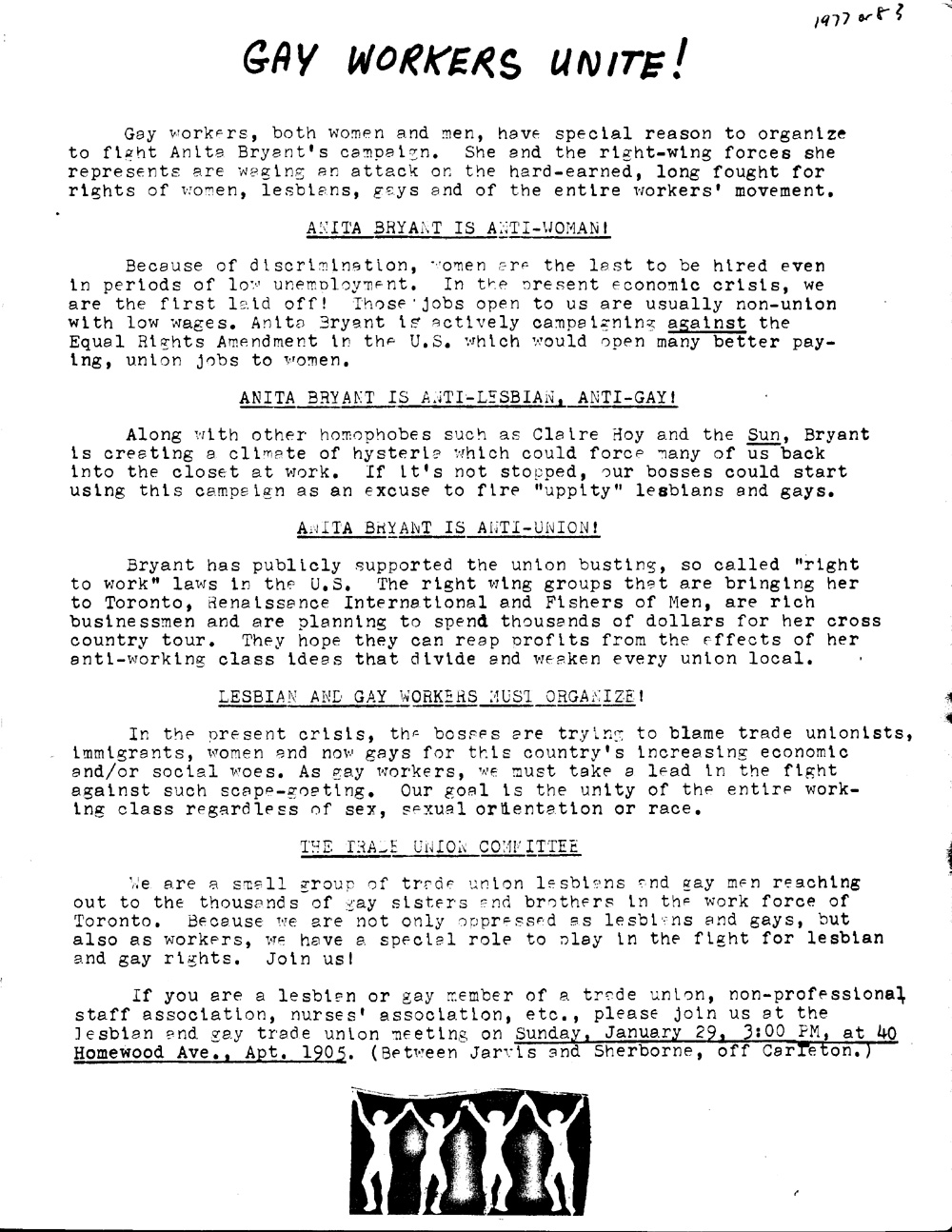
This is a real document from the 1977 demonstrations against the arrival of Anita Bryant in Toronto. Click to read the full statement and decide for yourself whether or not you would have participated in this call to action!
References:

 Caricature dawing of Anita Bryant taken from Workers World, 1977. Courtesy of:
Days Without Sunshine: Anita Bryant’s Anti-Gay Crusade. The Stonewall Library and Archives. http://www.stonewall-library.org/anita/

Gay workers Unite Leaflet from the Meeting Notes of the Gay Marxist Study Group, March 17 1977. Courtesy of the Left History Volume 9 Issue 2, Special Online Collection."Workers of the World Caress"
http://www.yorku.ca/lefthist/online/doc_pages/full/workersa.html

Fetner, Tina. "Working Anita Bryant: The Impact of Christian Anti-Gay Activism on Lesbian and Gay Movement Claims." Social Problems. 48.3 (2001): 411-428.

**Fictionalized 

1975: The Wrongful Dismissal of John Damien


[excerpt from the diary of John Damien**]
February 7, 1975.

Today was probably one of the hardest and most frustrating days of my life. After twenty years of dedicated work for the Ontario Jockey Commission as a trainer and jockey, I was let go today. While being fired is never easy, I think the reason why today has been so difficult is because I was fired without cause. I am one of the top three racing judges in Ontario and was, until recently, highly sought after for my talents and abilities. This was of course before the Commission became aware of the fact that I was, and always have been, gay. 
 
Sure I was never very active in any kind of organizing or politics on the basis - it just didn't interest me - but now that I have been put through this I feel as if I should have been all along. I am so frustrated with situation and I don’t know what to do. 

 July 1, 1975. 


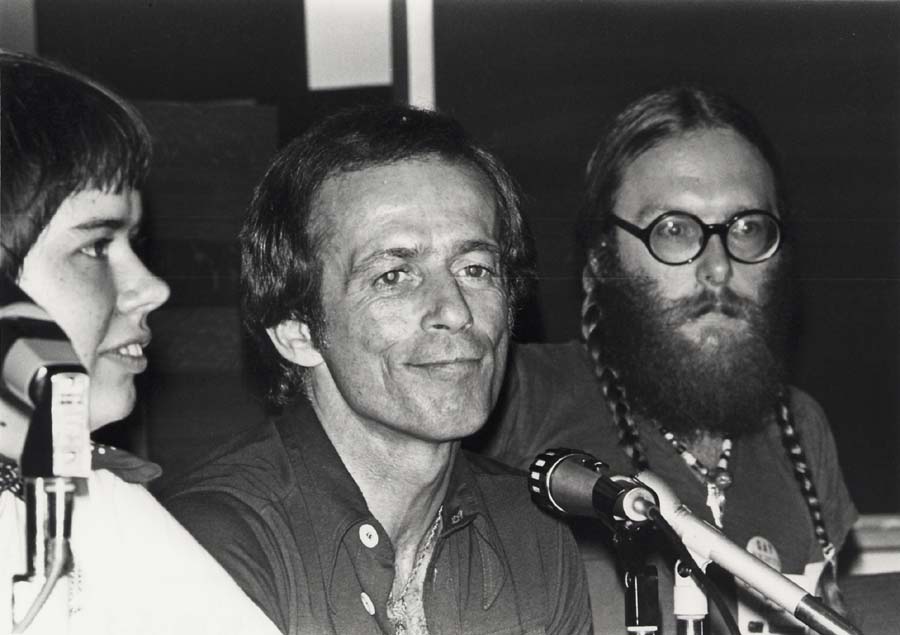
A photo of Chris Bearchell, myself and Charlie Hill speaking
at the founding conference of the National Coalition for Gay Rights in Ottawa earlier today.


So much has happened since the last time I wrote here. After all my initial frustrations I finally contacted the Ontario Human Rights Comission about my wrongful dismissal and argued that sexual orientation was implicit in the provincial human rights code. But they declined to accept my complaint. After that,  I was leaving one of my favourite bars, which also happens to cater to a mainly gay and lesbian clientele, and I saw an ad on the wall for an organization called GATE (the Gay Alliance Toward Equality). I made one simple phone call to GATE and since then things have been so much better for me. I have found a huge amount of support from within the gay community and beyond. People have helped me fund-raise for legal costs and have even pushed for rights I didn’t even know I had, like broadening the human rights code to include the ‘sexual orientation.’ Today I attended the founding conference of the National Coalition for Gay Rights in Ottawa with a few of my friends from GATE and to me this feels like only the beginning...

[end of entry]

The Canadian Human Rights Code was eventually amended in 1986 to include sexual orientation. Damien passed away six days later of pancreatic cancer. While it is important to remember the achievement itself, it is also necessary for us to recognize the contributions of brave and outspoken individuals who stood alone and acted as catalysts for change.

References:

Photo Credit: The Ottawa Journal, City of Ottawa Archives.

Smith, Miriam. Lesbian and Gay Rights in Canada: Social Movements and Equality-Seeking, 1971-1995. Toronto: University of Toronto Press, 1999.

**Fictionalized 

1971: The Body Politic is Published for the First Time.

Selected Covers from Body Politic: The public voice of Canada's burgeoning Gay Liberation Movement
[excerpt from the diary of a young Toronto gay rights activist**]

November 1971,
Today I pick up a copy of a new journal called The Body Politic. It was formed by activists like me right here in Toronto and it is the self-proclaimed voice of Canada’s national gay liberation movement. I have been waiting for something like this to come around for years as I have sat idly by while the the American gay rights movement has become increasingly organized and the Canadian voice has been incredibly muddled. Finally we have an outlet to to build up our own  movement that is better organized and better publicized.

After reading the first few pages of the journal I felt like this magazine would act as a call to action for my brothers and sisters in the closet – sending a message that you are not alone. Gay is good and gay is proud!


One article in this issue of The Body Politic written by a woman named Nancy Walker really stood out to me. She wrote:
No one is going to hand us the gift of freedom on a plate. We have to work for it. When progress is made, it is because a large number of us have done what is necessary to achieve our ends. If you want to live a freer, more natural, more socially mobile life, you have to participate, you have to be politically aware and politically active. It must be the concern of every gay person to attain civil rights for all (Warner 69).
Wow. To me this kind of talk really demonstrates how important it really is for gays and lesbians to have a public voice and a public presence. I think that over the years this paper will become one of the most significant achievements in the gay rights movement, not only to raise awareness about issues that affect our community but to provide us an outlet for creating this public voice. Today feels like an important day as the seeds of the movement are finally coming to fruition...

[end of excerpt]


References 


Photos collected from the Canadian Lesbian and Gay Archives
http://clga.ca/


Warner, Tom. Never Going Back: A History of Queer Activism in Canada. Toronto: University of Toronto Press, 2002.
**Fictionalized

1966: Art Depicting Lesbianism Faces Censorship

Feb. 6, 1966

[an excerpt from the diary of an artist living in Toronto, Canada]

Today my good friend Robert Markle finally had his day in court. About a year ago some of his nude paintings, displayed at Dorothy Cameron's Eros '65 gallery were unfairly confiscated by the supposed "morality police" of our fair city. While Robert would definitely claim to have had every intention of arousing emotions with his art, he always told me he viewed his nude paintings as sensuous rather than sexual. But today, an Ontario court magistrate claimed today that Robert went too far. The nude painting that caused by far the greatest public outcry was of two women in an intimate embrace.
.

[end of exerpt]

While this small moment of gay and lesbian artistic censorship may not initially appear to be of any particular significance, it was these small acts of everyday oppression that silenced gay and lesbian voices and resulted in the need for a full fledged gay rights movement during the 1970s. It is also significant that this issue pertains to issues of art and cultural expression as opposed to legal rights, as these were the kind of issues that impacted gays and lesbians on a day to day basis. Finally this event is significant insofar as it set a precedent that would impact a range of other gay and lesbian artists throughout the 1970s and 1980s.

What do you think about this issue? Was Markle's art pornography? Or freedom of expression? 

Watch this clip from the CBC news archives to help practice historical perspective taking and determine your best response:


References:

Photo Entitled Lovers lll by Robert Markle, 1963
Courtesy of the Centre for Contemporary Canadian Art.
Cops ban 'lewd' drawings.
The CBC Digital Archives Website.
Canadian Broadcasting Corporation.
Last updated: March 20, 2008.
[Page consulted on Jan. 20, 2011.]

Kinsman, Gary. The Regulation of Desire: Homo and Hetero Sexualities. Montreal: Black Rose Books, 1996.

1940: Feminist, Anarchist, Gay Rights Icon Dies in Toronto.

Excerpt from The Toronto Star, May 14 1940. 

Gadfly or Pesky Mosquito: It is impossible to ignore the impact of the controversial public intellectual Emma Goldman.


[...]


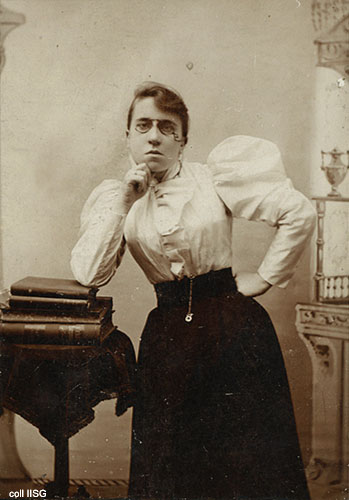
After finding herself exiled from the United States, Russian-born anarchist Emma Goldman died today of a stroke right here in Toronto, Canada. While most known for the publication of her Anarchism and Other Essays in which she tackles every topic from capitalism to prostitution, Goldman was also one of the first to publicly speak out in favour of the rights of homosexuals. In the midst of the Oscar Wilde trials she was quoted as saying: 
It is a tragedy, I feel, that people of a different sexual type are caught in a world which shows so little understanding for homosexuals and is so crassly indifferent to the various gradations and variations of gender and their great significance in life.  (Katz, 378-379)
 While many today may disagree with her controversial viewpoints, it is impossible to disregard the impact she has had on our city. The weekly lecture series she began in Toronto just over ten years ago in 1928 enlivened debate about the role of the anarchist movement in Canada.


References

Photo courtesy of the International Institute of Social History.
Emma Goldman in New York, c. 1890
From the Emma Goldman archive.
Komow and Landa photographers
http://www.iisg.nl/collections/goldman/a5-483.php

Katz, Jonathan Ned. Gay American History: Lesbians and Gay Men in the U.S.A. New York City: Penguin Books, 2002.

LGBTQ Events, Pre-WWII

LGBTQ Events: Pre-WWII
By: Christopher Taylor


1938: Gays and lesbians begin to be officially rounded up by the Gestapo in Germany and its conquered territories, and sent to the concentration camps. They are ordered to wear purple triangles to identify themselves (Wolf, 2009, p. 59).


1934: In July, the Night of Long Knives occurs in Germany. Hitler removes ‘leftists’ from the National Socialist Party. One of the targets is Ernst Rohm, who is accused of creating homosexual cliques among the Nazi militias (Adams, 1987, p. 52).


(May 10th burning of books by the Nazis. Some of these may have been leftovers from the May 3rd burnings of the Scientific-Humanitarian Committee's material, the largest archive of gay and lesbian texts and photos from before the Second World War).


1933/1934: Burnings in Berlin, the Night of Long Knives


Dear Diary,


Things are growing dark across the world for those of us in the LGTBQ community. Germany has always been where most of the leadership for the community has come from, ever since the Scientific-Humanitarian Committee was founded in 1897. Throughout the 1900s, 1910s, and 1920s, they and the other groups within the German community fought to change the laws of Germany and to represent gays so that they would no longer be the target of persecution. All of that changed today.


In Berlin, one hundred student members of the Nazi party attacked the Institute, burning 12,000 books and 35,000 pictures, destroying much of the history of the gay rights movement in Germany, and beyond, since they were at the heart of much of the movement (Adams, 1987, p. 50-51). Hitler is already talking about how gays are ‘Anti-Aryan,’ impure, and diseased, how they threaten his image of a perfect German nation.


This marks, perhaps, the beginning of the end for the open elements of the gay movement until after the Second World War. At this point, gays begin being openly targeted in Germany and in other areas occupied by the Germans.


With regret, dear diary, my previous predictions of better fortune have proven false. These are dark times for gays and lesbians around the world, indeed.


Sincerely,
Chris Taylor


(Photograph of Radclyffe Hall, writer of The Well of Loneliness, perhaps the first publicly successful pieces of lesbian fiction in the modern era.)

1928, Radclyffe Hall publishes The Well of Loneliness

Dear Diary,

I finally managed to purchase a copy of Radclyffe Hall’s book The Well of Loneliness. I had to travel to the US to get a copy of it, since it was banned in Britain after an obscenity trial (Duder, 2010, p. 28-29). The book’s main character is a man named Stephen Gordon, who calls himself a ‘congenital invert,’ which, at this time, means someone who is either lesbian or gay (and usually the former). In 1929, the US allowed the book to be published after another obscenity trial. Apparently, 100,000 copies were sold in its first year alone (p. 29)! Hall used a lot of the language of the day from sexology to define lesbianism and homosexuality. Even the term ‘congenital invert’ suggests that being gay was something one was born with, which could be treated medically. The character “popularized the medical definition of homosexuality as an inescapable, emotionally tormenting, natural deviance” (Wolf, 2009, p. 51).

Even though later lesbians would continue to read it, and it continued to be a symbol for the LGBTQ movement as a ‘first’ for a lesbian writer, many continue to view it as portraying gays in a negative fashion. The main character is tormented, lonely, and introverted. Still, the book remains popular to the present day.

Seems like things are finally starting to look a little better for the community, despite all the challenges.

Sincerely,
Chris Taylor

1920s: The Soviet Union rejects persecution of gays, calling what happens in the bedroom a private matter. However, by the 1930s, half of the Communist party leadership is arrested, and several charged as homosexuals by Stalin (Adams, 1987, 46-47). The earlier Soviet attitude leads to much of the leftward drift of the gay rights movement, and targeting by those on the right.


1919-1921: The pro-gay Institute for Sex Research is founded in Germany. By 1921, the World League for Sexual Reform, a global organization for gay rights, has a membership of 130,000 (Adams, 1987, p. 23-24).

(Maude Allen, as Salome, in the Oscar Wilde play of the same name, from an earlier production from the London version during which time she faced lurid accusations.)

1918: Maude Allen, Salome, and Conspiracy Theories

Dear Diary,

Maude Allen, a Canadian-born dancer, was supposed to perform the leading role of Salome in Oscar Wilde’s play of the same name. Maud was born in Toronto, in 1880 (Lesbian and Gay Heritage in Toronto, 1982, p. 3). She moved around a lot as a child, to San Francisco as a child with her family, and to Europe for about five years to study music and dance (p. 3). She debuted in Vienna as a performer in 1903 (p. 3).

Unfortunately, the play was attacked in a newspaper article by Noel Pemberton-Billing. He accused it of being a front for the German Black Book—an organization of nearly 47,000 people accused of having “doubtful morality,” which at this time, meant being gay (p. 3). Allen was also accused by Pemberton-Billing of being part of another secret society attempting to use their access to political leaders in England to spy on the British during the war (p. 3). The accusations were dropped only when Allan sued Billing for libel. She continued to dance and perform until 1938, when she was injured in an automobile accident, and even served as an ambulance driver (p. 3).

This goes to show that the attacks against the LGBTQ community were not just against men, but women also, and often gays and lesbians were used as scapegoats in a conspiracy theory. Years later, the Nazis would do the same thing.

Also in 1918: While certainly not as public as the Allen trial, there was a more positive example of gay and lesbian activity during the time period. In 1918, Edith (Bud) Williams and Frieda Fraser began their life-long correspondence and relationship (Duder, 2010, p. 35). Fraser became associate professor at the University of Toronto in 1936, full professor in 1949, and Williams became only the second woman in Canada to graduate from veterinary school, in Guelph, in the 1930s (p. 36-37). While this is not the only example of lesbian writing, or even of lesbians living together, their letters are the largest body of lesbian writing from the pre-WWII era, and one of the longest-lasting.

In short, dear diary, while things were still very grim for LGBTQs, at least there was some light for some people in Canada.

Sincerely,
Chris Taylor

1915: Emma Goldman tours the US on a speaking tour to support gay rights (Adams, 1987, p. 41). She eventually lives in Toronto three times: in 1926, 1934-1935, and 1939-1940, when she passed away at Toronto General Hospital. Her house was at 324 Spadina (Lesbian and Gay Heritage in Toronto, 1982, p. 3-4).


1914: British Society for the Study of Sex Psychology founded (Adams, 1987, p. 37).


1907: Germany's Eulenburg Scandal. A paper in Berlin accuses the highest ranks of the German government of engaging in homosexual activities. A crackdown ensues on the paper and on gays in Germany (Adams, 1987, p. 21).

1906: Flora MacDonald Denison represents Canada at the International Suffrage Alliance in Copenhagen. This leads to a lifetime of working with lesbian and feminist activists (Lesbian and Gay Heritage in Toronto, 1982, p. 3).

1897: Founding of the Scientific Humanitarian Committee in Berlin by Max Spohr, and Erich Oberg. One of the first pro-gay organizations in the world in the modern world (Adams, 1987, p. 17).


1895, the Wilde and Hoskins Trials

(Regina’s warehouse district in 1903, eight years after the Hoskins trial. By this point, Hoskins had already left town due to an informal exile.)

May 22nd, 1895:
Dear Diary,

My goodness, this has been a terrible time to be a gay or a lesbian in public! In February, Oscar Wilde—yes, the Oscar Wilde, the playwright—sued the Marquess of Queensbury for calling Wilde a sodomite. This was not punishable by death or even major imprisonment, anymore, but the charge was serious enough. Wilde lost the trial—which mean that Queensbury’s accusation was accurate. Wilde himself was taken to court by the British government in April. The judge called him a “corruptor of youth,” and the “centre of a circle of extensive corruption of the most hideous kind among young men” (Adams, 1987, p. 35), even though the people Wilde was involved with were of age! He was condemned to two years of hard labor (32), and died a few years later. Wilde was able to be tried because of existing British laws concerning protecting young men and women from being 'corrupted,' as opposed to sodomy (which was no longer as big a legal threat), therefore ensuring that the courts had a precedent for attacking gays for some time to come (Bulllough,1979, p. 40)! From a Canadian’s perspective, Robbie Ross, one of Wilde’s friends, was himself put on trial in 1914, and was forced to retire in shame from public life (Lesbian and Gay Heritage in Toronto, 1982, p. 2).

Furthermore, this lead to copycat trials all over the British Commonwealth, including in Canada. On May 22nd, 1895, Frank Hoskins, of Regina, and two “young boys” (in fact 17 and 26), were arrested for gross indecency, and accused of ‘Oscarism’ by locals (Dick, 2009, p. 107, 113). By this point in Canadian history, the government had changed the laws concerning male homosexuality to include charges of 2-5 years in prison (117)—laws which would remain on the books for 77 years (119). Hoskins and the two other men (Hume and McPherson) were caught together by onlookers who had followed them home, and looked through Hoskin’s store windows (123-127). Hoskins was fined 200$, and McPherson and Hume 50$ and 20$, respectively (131-133). The trio never returned to the community, and Hoskins, a formerly successful businessman, never resurfaced. This setback to the LGBTQ community was one of many trials against gays throughout the early 20th Century, and while the gay community had many gains, these and other incidents caused many gays to remain in the closet. It also began the public perception of gays as being effeminate aesthetes. Ironically, many gays began to find each other through newspaper descriptions of ‘gay’ clubs in the newspapers covering the various trials (Wolf, 2009, p. 42).

More information as it becomes available, dear diary!

Chris Taylor


1880s: In France, one study reports 7,242 homosexuals found by the Paris police, of whom 3,049 were Parisians, 3,709 from the provinces of France, and 484 were foreigners (Bullough, 1979, p. 6).


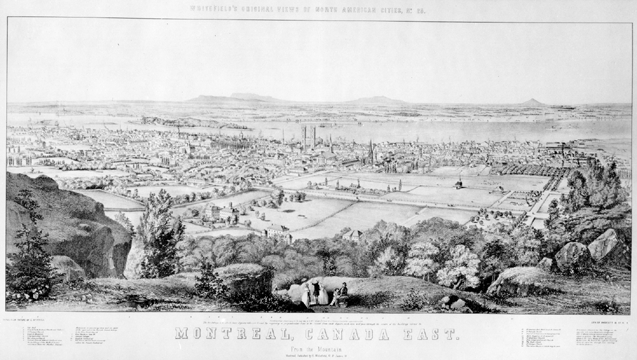
(The view from Mont-Royal looking over Montreal, 1852. This would have been a decade and a half before Moise Tellier’s arrest.)


1859/1869: The Consolidated Statutes, and the Arrest of Moise Tellier

Dear Diary,

This month was quite eventful! Ten years ago, Parliament passed the Consolidated Statutes of 1859. This repatriated the laws of our British heritage to Canada. Unfortunately for individuals who are gay, lesbian, bisexual, or two-spirited, the laws kept the old sodomy laws on file for Canadian law (Dick, 2009, p. 117). The death penalty would still be carried out on anyone caught. That said, by this year (1869), the law now only provides a life sentence as a maximum punishment.

This was fortunate for Mister Moise Tellier of Montreal! Tellier was a businessman, who owned a cake and apple shop on Craig Street (modern St-Antoine). The rumors about Mr. Tellier were that the shop was a place for men to go and be able to meet and, possibly, have sex with other men. It was one of, if not the first relatively open establishment for gays in all of Canada. Mr. Tellier was arrested when he attempted “indecent assault” on a police constable in Montreal (Bulletin des Archives gaies du Quebec, 1992, p. 3). Whether this was an actual assault, a form of entrapment, or an elicitation of sexual activity is not presently clear.

In short, dear diary, a lot of things are going on for gays and lesbians in Canada this year, and not all of it good!

Yours sincerely,
Chris Taylor


1864: Karl Ulrichs, a Hanover lawyer, publishes arguments in his books that suggest that homosexuality is a congenital issue, like left-handedness or cleft palates (Adams, 1987, p. 14).

1810: Alexander Wood, a Toronto businessman and politician, is accused of illicit (homosexual) activities with other men in the city, and informally exiled for two years. In 1823, when he attempts to run for office once again, “Chief Justice Powell refused to receive Wood’s oath of office” (Lesbian and Gay Heritage in Toronto, 1982, p. 1). This is one of the first instances of anti-gay prosecution in Canada.


Sources:


1933 Book Burnings (1933). [Nazi/SS officers burning books in Berlin, May 10, 1933]. United States Holocaust Memorial Museum. Retrieved January 17th, 2011 from http://www.ushmm.org/research/library/bibliography/photo.php?lang=en&content=1933_bookburning

Adams, B. (1987). The Rise of a Gay and Lesbian Movement. Boston: Twayne Publishers.

Bullough, V. (1979). Homosexuality: A History. New York: New American Library.

Bulletin des Archives gaies du Quebec (1992). Quebec: L’Archigai: Archives gaies du Quebec. Retrieved January 12, 2011, from http://www.agq.qc.ca/fileadmin/Archigai/Archigai_1992.pdf

Dick, L. (2009). Same-sex Intersections of the Prairie Settlement Era: The 1895 Case of Regina's "Oscar Wilde.” In Social History (42:83), pp. 106-145 Retrieved January 9th, 2011, from http://search1.scholarsportal.info.myaccess.library.utoronto.ca/ids70/view_record.php?id=1&recnum=0&log=from_res&SID=58869ab291b9e8f7278a2ab02bc4c56b&mark_id=search%3A1%3A0%2C0%2C1

Duder, Cameron (2010). Awfully Devoted Women: Lesbian Lives in Canada 1900-1965.Vancouver: UBC Press.

“Lesbian and Gay Heritage in Toronto” (1982). Toronto: Canadian Gay Archives.

“Maude Allen as Salome.” (c.1906-1910). [Actress dancer Maude Allan as Salome, c. 1906 – 1910]. Wikipedia Media Commons. Retrieved January 21, 2011, from http://en.wikipedia.org/wiki/File:MaudeAllanSalomeHead.jpg

Radclyffe Hall (1928). [Photograph of Radclyffe Hall]. Photograph courtesy of Russell-Hulton
Archives. Britannica Online. Retrieved January 16th, 2011, from http://www.britannica.com/EBchecked/media/56904/Radclyffe-Hall-1928

Warehouse District and Railyards (c1903). [Photograph of the warehouse district and railroads of Regina]. Regina: the Early Years. Retrieved January 16th, 2011, from http://scaa.usask.ca/gallery/regina/north/warehouse_b_571.html

Whitefield, E. (1852). [Montreal from Mont Royal]. McGill Archives. Retrieved January 17th, 2011, from http://www.archives.mcgill.ca/pictures/pr014517.gif

Wolf, Sherry (2009). Sexuality and Socialism: History, Politics, and Theory of LGBT Liberalism. Chicago: Haymarket Books.